-
Image
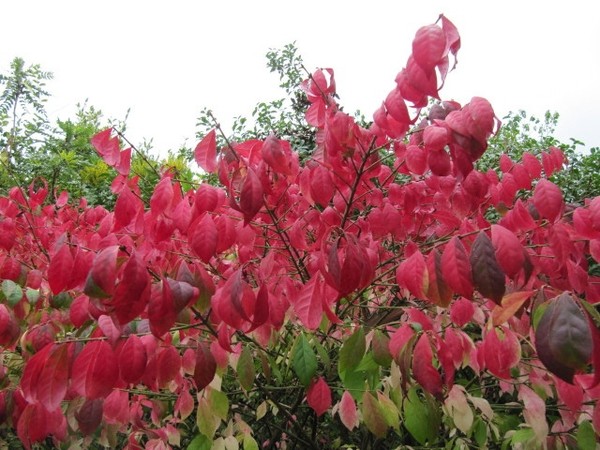
 Burning bush euonymus. Photo by Leonora Enking. Shared under a Creative Commons Attribution-No Derivatives license.
 -
Image
 Burning bush euonymus. Photo by Leonora Enking. Shared under a Creative Commons Attribution-No Derivatives license.
COLUMBIA, Mo. – While trees remain the jewel in the crown of fall foliage, don’t overlook their shorter relatives, said University of Missouri Extension horticulturist David Trinklein.
In the home landscape as well as in the wild, woody shrubs also provide fall color to add beauty to the season. At a time when many summer flowers are in decline, colorful shrubs can extend garden enjoyment.
Early autumn outings are made more enjoyable by the bright red leaves of native sumacs. Fragrant sumac (Rhus aromatica) and smooth sumac (Rhus glabra) often can be seen growing along roadsides. These two species also are suitable for the home landscape and will provide good fall color at other times as well, said Trinklein.
Perhaps a bit more decorative is cut-leaf staghorn sumac (Rhus typhina ‘Laciniata’), selected from a native sumac species. Capable of growing to a height of about 20 feet, it boasts large, deeply divided leaves that turn from a beautiful orange to a fiery red in the fall. Like other sumacs, it is durable and tolerates poor soil along with dry, sunny exposures.
Tiger-eyes sumac (Rhus typhina ‘Bailtiger’) is yet another selection of staghorn sumac. It boasts chartreuse-green foliage in the spring, yellow foliage during the summer and fiery orange foliage in the fall. Shorter than cut-leaf staghorn sumac, it grows to only about 6 feet.
One of the most attractive and best-known shrubs for fall color is dwarf burning bush euonymus (Euonymus alatus ‘Compactus’). The species is considered invasive by some, especially when planted in more rural settings. When planted in urban areas, ‘Compactus’ is much less so. Additionally, sterile ‘Compactus’ cultivars such as ‘Fire Ball Seedless’ are available.
Oakleaf hydrangea (Hydrangea quercifolis) is a lesser-known shrub that provides good reddish-purple fall color. In addition to attractive fall foliage color, this hydrangea produces white flowers in early summer that turn pinkish purple by midsummer and brown in the fall. While it can tolerate some sun, oakleaf hydrangea may fade and color prematurely when heat-stressed. The cultivar ‘Ruby Slippers’ is widely considered to have some of the best and most brilliant red fall foliage among the oakleaf hydrangeas.
The viburnums also exhibit modest fall color while being good landscape specimens. They include American cranberry bush (Viburnum trilobum), Korean spice viburnum (Viburnum carlesii) and several other related species in the Viburnum genus. Most will develop red or reddish-purple fall foliage color. Additionally, they bear attractive and often fragrant flowers in the spring.
Japanese barberry (Berberis thunbergii) is a common landscape shrub that carries with it the reputation of being invasive, especially in eastern states. Crimson pigmy barberry (Berberis thunbergii ‘Atropurpurea Nana’) is a dwarf form of the species that develops far fewer fruits and is considered much less of a threat to become invasive. It has deep burgundy foliage the entire growing season that turns crimson red in fall.
Dogwoods are another group of woody plants that develop attractive reddish-purple fall leaf color. The shrubby types, such as silky dogwood (Cornus amomum) or red osier dogwood (Cornus sericea) are good choices for landscape use in the proper setting. They grow 6-10 feet high and almost as wide. Where space is available, they make durable, low-maintenance shrubs that add beauty to the landscape. The red osier dogwood, commonly called red twig dogwood, also is grown for the reddish color of its bark, which provides interest throughout the winter.
While most of the shrubs mentioned have red or reddish-purple fall foliage color, some shrubs provide other colors as well. Forsythia (Forsythia spp.) is noted for its bright yellow flowers born in early spring. Most, however, produce yellow-green foliage color in fall. Additionally, a bright yellow leaf color is produced in fall by common witch-hazel (Hamamelis virginiana). This woody species develops into a large shrub or, at times, a small tree. In addition to yellow fall leaves, this plant sometimes produces yellow flowers after its leaves have fallen.
Additional to those mentioned, cotoneaster, aronia, some of the spireas and a few species of shrub rose are worth considering.
“Colorful shrubs provide a special finishing touch to the landscape. No matter your taste, you are sure to find a shrub to accommodate it,” said Trinklein.
Photos
Fragrant sumac. Photo by James H. Miller, USDA Forest Service, Bugwood.org. Shared under a Creative Commons Attribution 3.0 license.
Burning bush euonymus. Photo by Leonora Enking. Shared under a Creative Commons Attribution-No Derivatives license.