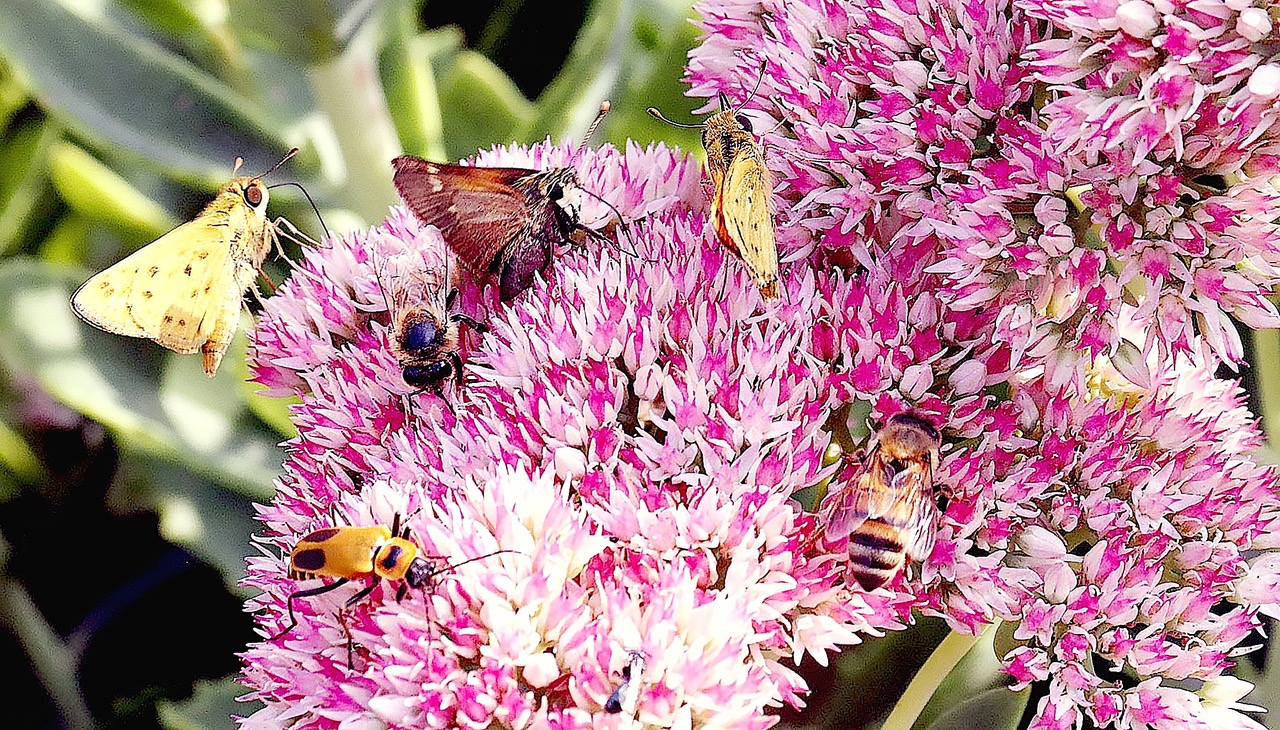
This drought-resistant succulent blooms after most garden flowers have faded.
-
Image
 Autumn Joy sedum’s large flower heads bloom when the colors of other flowers fades. This drought-resistant perennial is a favorite of pollinators. The National Garden Bureau named sedum its 2026 Perennial of the Year. Photo by Linda Geist.
COLUMBIA, Mo. – Mention succulents to an avid gardener and it isn’t long until the conversation gravitates toward the sedums.
A favorite among gardeners, sedums are recognized for their durability, drought tolerance and ability to thrive in even the most challenging environments, said University of Missouri Extension horticulturist David Trinklein.
To promote this versatile plant, the National Garden Bureau has named sedum its Perennial of the Year for 2026.
A member of the Crassulaceae plant family, Sedum is a genus of succulent, herbaceous perennials with fleshy, flat or rounded leaves, depending on the species. The genus name comes from the Latin word sedeo, meaning “to sit,” referring to the habit of many sedum species to sprawl over the ground.
The genus may contain as many as 400 species, most of which are native to the Northern Hemisphere. Some of them spread along the ground and achieve a mature height of only a few inches; others have an upright growth habit and reach heights up to 24 inches. Many sedum cultivars prized by gardeners today are hybrids.
The sedums are true succulents, meaning they have both morphological and physiological adaptations that help them survive hot, arid conditions. The taller sedums produce large clusters of tiny, star-shaped flowers in shades of pink or red and can be used in borders or pollinator gardens. Because they tend to bloom in late summer and into fall, they are excellent for extending the flowering season of a pollinator garden.
Although they also bear attractive flowers, the low-growing, spreading sedums originally were grown for their foliage, which comes in a wide spectrum of colors, including shades of green, blue-gray, silver, deep purple, burgundy and bright yellow/chartreuse. They spread via roots that form on their horizontal, creeping stems. Spreading sedums are ideal for sunny slopes, in rock gardens, as low-maintenance ground covers and even for green roofs. Sedums should not be planted where they will be damages by human foot traffic.
Sedums are easily grown in full-sun settings in average soils. As true succulents, sedums must have good soil drainage to perform well. Sandy to gravelly soils of average to moderate fertility are preferred. As mentioned above, they are extremely heat- and drought-tolerant but can withstand some light shade. Plants grown in overly rich soils or in too much shade will produce weak growth.
Sedums are relatively pest-free. However, because of their succulent leaves and stems, slugs and snails can cause problems. Root rot is possible in wet and/or poorly drained conditions. Taller sedum hybrids with large flower heads are susceptible to flopping. Avoid this by providing full sun conditions and planting in soils that are not too moist or rich. Pinching in spring can also force stems to grow thicker and bushier.
Popular sedum cultivars and their mature heights:
- Sedum spectabile ‘Brilliant’ (18-24 inches)
- Sedum ‘Autumn Joy’ (18-24 inches)
- Sedum ‘Mr. Goodbud’ (16-18 inches)
- Sedum telephium ‘Dark Magic’ (12-15 inches)
- Sedum ‘Dazzleberry’ (4-6 inches)
- Sedum ‘Firecracker’ (4-6 inches)
- Sedum spurium ‘Dragon’s Blood’ (4-6 inches)
- Sedum ‘Rosey Glow’ (4-6 inches)
- Sedum kamtschaticum ‘Weihenstephaner Gold’ (3-6 inches)
- Sedum rupestre ‘Angelina’ (3-6 inches)
Photo
Autumn Joy sedum’s large flower heads bloom when the colors of other flowers fades. This drought-resistant perennial is a favorite of pollinators. The National Garden Bureau named sedum its 2026 Perennial of the Year. Photo by Linda Geist.