-
Image
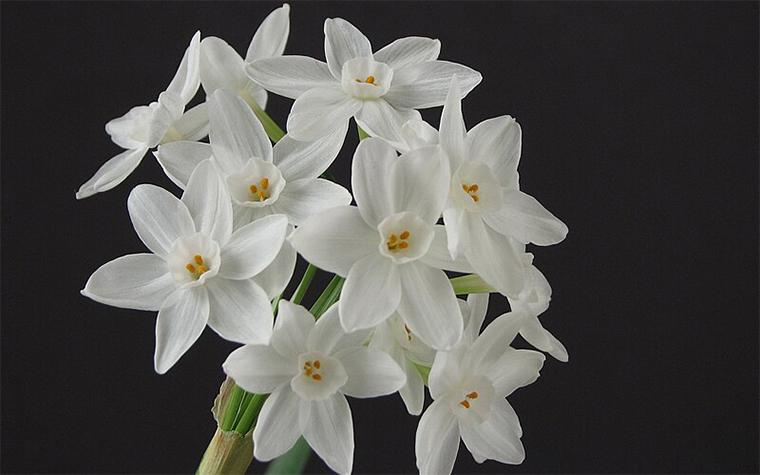 Paperwhite narcissus (Narcissus papyraceus). Photo by Ceasol. Shared under a Creative Commons license (CC-BY-3.0).
COLUMBIA, Mo. – During the dull, lifeless days of winter, gardeners long for a hint of spring and the ensuing outdoor growing season.
From the Mediterranean region comes a bulb that has given endless winter pleasure to plant lovers everywhere, said University of Missouri Extension horticulturist David Trinklein. The bulb is the paperwhite narcissus, one of the easiest bulbs to force into bloom during winter months.
“The clusters of small, star-shaped flowers of paperwhites and their distinctive fragrance are pleasant during the bleak days of December and January,” Trinklein said. “For anyone who loves flowers in winter, forcing these bulbs into bloom can be rewarding. They also are ideal for children’s gardening projects.”
Paperwhite bulbs are normally available for sale when amaryllis bulbs become available. You can buy paperwhite “kits” that contain several bulbs, a growing medium and a plastic pot. After planting, bulbs normally need four to six weeks to come into flower. Succession planting at two-week intervals in November will provide fragrant flowers through February.
Trinklein said that most people prefer the white cultivars of paperwhites, although yellow ones are available. The yellow cultivars may be found under several names, including Grand Soleil d’or and Rising Sun narcissus. “The deep yellow color of the flowers of these cultivars adds brightness and fragrance to a room, though the flower clusters tend to be smaller than those of the white cultivars,” he said.
For best results, keep bulbs cool if not planting immediately after purchase. Bulbs stored at warm temperatures will be poorer quality and may fail to flower when planted later. Paperwhites are not winter-hardy at Missouri’s latitude and should not be planted outdoors.
Plant bulbs in a well-drained potting mix or in water-filled bowls containing pebbles or gravel. Bulbs planted in a potting mix tend to be easier to care for and are less prone to topple over than those grown in gravel and water, Trinklein said. Paperwhite bulbs are not useful for a second forcing. They are normally discarded after blooms fade.
To grow paperwhites in gravel and water, use a shallow bowl wide enough to hold four to six bulbs. Space bulbs and plant them deep enough so they are almost covered with gravel. Bulbs planted too shallow tend to be pushed out of the bowl by developing roots.
Check bulbs occasionally and push them back into the gravel as needed. Keep the water in the bowl level with the base of the bulbs. Don’t cover the entire bulb with water. As roots develop, the water level in the bowl can be allowed to drop, since the roots will take it up. There also will be less danger of bulb rot if the water level drops.
“Forcing temperatures are important in developing attractive paperwhites,” said Trinklein. To prevent foliage and flowering stems from becoming too leggy, keep the bulbs cool after planting.
Temperatures close to 45 F are ideal during the early stages of growth. Light is not needed until top growth from the bulbs begins. As leaves begin to develop, move the bowl or pot to a bright window in a cool room. If possible, move to a cooler location after leaves are developed enough so that flower buds are visible in the center of the leaf cluster. Temperatures in the 50-degree range, particularly at night, allow good development without becoming excessively leggy. Growth and flower development can be accelerated by subjecting bulbs to warmer conditions, but plants will become taller.
Check bulbs in gravel and water occasionally to make sure that the water has not “soured.” If the water has a foul odor, drain and replace with fresh water. This may be difficult for some containers. Place the bowl under the faucet in the sink and let water slowly run into it. This will gradually wash the gravel and replace fouled water with fresh. Drain off excess water after each washing.
Photo
Paperwhite narcissus (Narcissus papyraceus). Photo by Ceasol. Shared under a Creative Commons license (CC-BY-3.0).
