From club meetings to directing a summer camp, Allen Garner found that the greatest value of 4-H was gaining the confidence to lead, adapt and solve problems.
-
Image
 Missouri 4-H alum Allen Garner is an attorney in Independence.
 -
Image
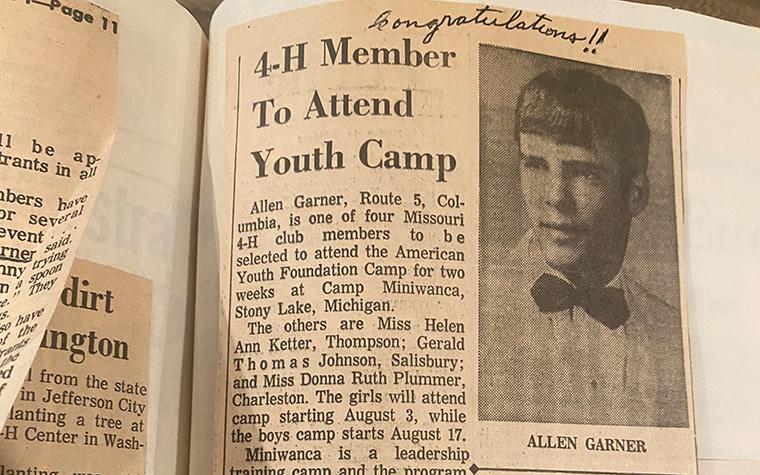 Allen Garner attended 4-H Youth Camp in Michigan as a teen.
 -
Image
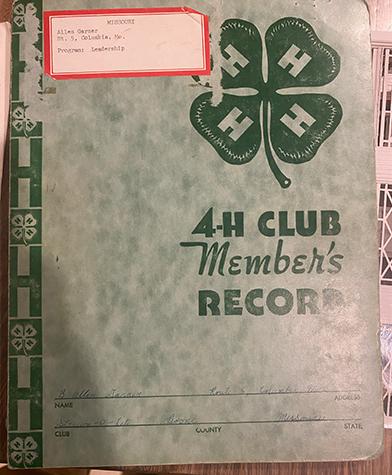 4-H club member record books like this provide a detailed chronicle of a 4-H'ers activities and personal growth.
 -
Image
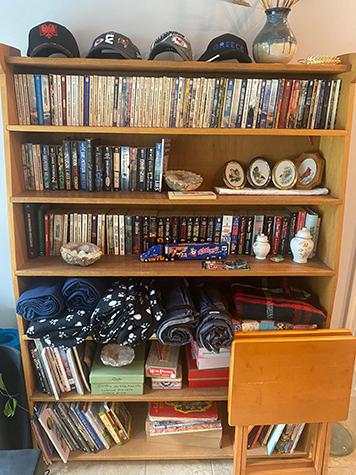 Allen Garner became a skilled woodworker through his 4-H club activities.
As a 4-H’er in the 1960s, Allen Garner learned woodworking, wiring electric appliances, how to raise a steer and baking bread, among other things. But some of his most formative experiences were not connected to a particular project. He was about 13 when he was put in charge of rewriting the bylaws of his club, Strawn-O-Lite, based in the community of Strawn School, a small, rural school just outside of Columbia, Mo.
The assignment required him to understand how an organization conducted its business, elected officers and established its rules, an early introduction to drafting documents and parliamentary procedure.
“That turned out to be a useful experience later in life,” he says. In his work as an attorney, he often finds himself writing and reviewing documents such as bylaws, contracts, charters, amendments, ordinances and statutes.
At the time, Garner wasn’t planning a career in the law. He wanted to be a fighter pilot, but a change in his eyesight ended that possibility. He then decided he would become a nuclear physicist — “just because it sounded cool” — until he learned what that career would require. By his junior year of high school, he had settled on law school.
He earned a bachelor’s degree in public administration from the University of Missouri in 1973 and a law degree from MU in 1977. He went on to serve as a city attorney for Eldon for 25 years, followed by similar work with Jefferson City and Independence. He now has his own practice, providing legal guidance to local governments, nonprofit organizations and an insurance company.
Learning to lead at a young age
At Strawn-O-Lite, young members were given responsibilities early. Garner started as a game leader and moved through club offices as he got older. Not everyone became president, he says, but many members worked their way through a series of leadership positions.
“So you would learn skills in the projects,” he says. “And then in the club meetings and the club activities, you would learn people skills, leadership skills.”
During summers at Clover Point, a 4-H camp at the Lake of the Ozarks, Garner also took on increasing responsibilities. After several years as a camper, he became a counselor and eventually assistant director of the camp. He was only 19 when he took over as camp director, a position he held for several summers.
It was also where he met his future wife, Beth, who was a counselor when Garner was assistant director. She later became a lifeguard and eventually served as camp director herself.
As camp director, Garner had ample opportunity to exercise the problem-solving skills he acquired in 4-H. The camp’s craft program had a budget of just 50 cents per child. “You couldn’t so much for 50 cents, so they would make lanyards. One year they made Popsicle-stick boxes. Most of those boxes were used for karate practice.
He decided to introduce ceramics. There was one problem: Ceramics takes considerably longer than a five-day camp. A mold normally had to sit for about 24 hours before it could be opened. Then the piece had to be trimmed, dried, fired, glazed and fired again. The entire process could take 10 days or more.
Garner devised a system in which counselors arriving for an earlier camp would pour the molds. The pieces could then be processed between camps, creating an assembly line that allowed campers to complete ceramic projects during their five-day stay.
The solution wasn’t perfect. The ceramics instructor Garner consulted was “aghast” that they had shortened some of the ideal waiting periods. But it worked. The campers enjoyed it, the program continued for several years, and some of the pieces have lasted nearly 50 years.
“That’s something else that 4-H taught you,” he says. “How to figure out a solution to a problem, even if it wasn’t perfect, but it was better than the alternatives.”
That kind of self-reliance, Garner says, is one of the lasting benefits of 4-H. Learning how to use tools, complete projects and solve problems gives young people skills they can apply in situations far removed from the original project.
Tim Tanner, senior program director for the University of Missouri Extension 4-H Center for Youth Development, says that’s a common theme among 4-H alumni. “When you talk with someone who was deeply involved in 4-H years ago, they may remember a specific project or event, but the memories that endure are the life and social skills they gained along the way,” Tanner says. “Learning how to solve problems, fail forward, take good guidance from caring adult mentors, and work with people from different backgrounds can have an impact that lasts a lifetime.”
Passing the benefits forward
Allen and Beth Garner’s own children also participated in 4-H. His son Kyle chose some of the same interests Garner had, including entomology, giving father and son another shared experience.
“When your children choose some of the same things that you have chosen, whether it be foods or in my case, with my son, entomology, it gives you another level of connection,” he says.
That connection, he adds, can provide parents and children with a shared space outside their usual roles.
Garner has remained involved with 4-H and MU Extension as an adult, including service on the Jackson County Extension Council and the state 4-H council. Those experiences have given him a perspective on how the program has changed.
The close-knit community centered around Strawn School is gone. As small rural schools were consolidated, 4-H clubs became less closely tied to individual communities, and participation increasingly became organized around individual projects.
But Garner sees that evolution as necessary. “You have to meet people where they are.”
He believes Missouri 4-H has done a good job adapting its curriculum and adding new projects and flexibility while preserving the traditions that remain valuable.
For Garner, that ability to adapt is important because the fundamental purpose of 4-H remains much the same: giving young people opportunities to learn, lead, solve problems, work with others and become more self-reliant.
He and Beth continue to support 4-H because they have seen those benefits firsthand.
“We see the tremendous value that we received, we see the value that it is still providing and we want to ensure that it continues to be able to provide that value to the next generations as they come up.”
And his advice to parents considering 4-H is straightforward.
“Your child will grow and will be better for that experience, no matter what they choose in the way of projects or how much they participate,” Garner says. “The opportunity for growth is unlimited and your child will make strides.
“As a side benefit, you will make strides in your relationship with your child.”