-
Image
 Research led by MU Extension agronomy specialist Rudra Baral shows that forage soybean can deliver high forage biomass, strong forage quality, good water use efficiency and a positive economic return under rainfed conditions. Photo courtesy of Rudra Baral.
 -
Image
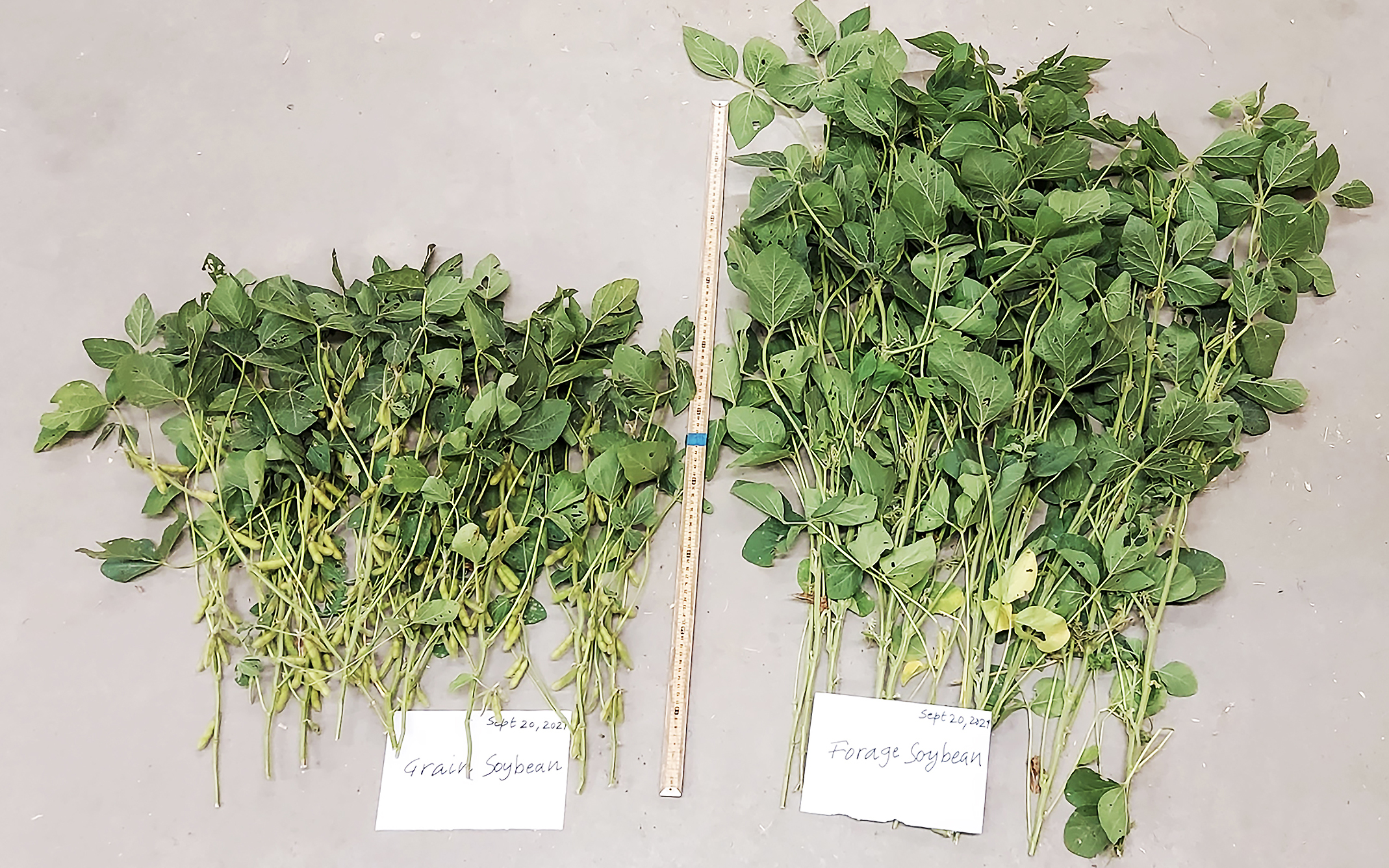
 Soybean and forage soybean planted on June 6, 2021, and harvested on Sept. 20, 2021. The forage soybean is nearly twice as tall and still appears to be in the vegetative stage, while the grain soybean has already reached the pod development stage. Photo courtesy of Rudra Baral.
TUSCUMBIA, Mo. – Livestock producers across Missouri continue to face rising feed costs, unpredictable weather and seasonal forage shortages during the summer. A recent study led by University of Missouri Extension agronomy specialist Rudra Baral found that forage soybean shows promise for bridging the summer forage gap.
Baral’s research shows that forage soybean can deliver high forage biomass, strong forage quality, good water use efficiency and a positive economic return under rain-fed conditions.
Planting date is critical
Forage soybeans yielded an average of 6 tons per acre of dry matter when harvested at the R3 (beginning pod) growth stage.
“Delaying planting to early July reduced yield by 51% at the same stage, showing that planting date is one of the most important management decisions for this crop,” says Baral.
The study also reported a water use efficiency of 450 pounds per acre per inch of water and a net profit of around $135 per acre with a 32% return on investment.
“The crop is attractive not only for yield but also for feed value,” says Baral. Crude protein stayed relatively stable at about 19% to 21% from V3 to R3, while late planting improved forage quality by reducing fiber and lignin and increasing digestibility. Researchers noted that forage soybean biomass was almost double under optimum planting compared with late planting, and the crop can reach about 5 feet under good conditions.
“For Missouri, that makes forage soybean a strong candidate for bridging the summer forage gap, especially in double-crop systems after wheat harvest,” says Baral.
It can be used as grazing, hay, green chop or silage, and it may also complement sorghum-Sudangrass or pearl millet in forage rotations. “Because it fixes nitrogen and performs well in rain-fed systems, it offers producers both agronomic and economic advantages,” says Baral.
Management matters
The best planting window in Missouri is mid-May to late June, with mid-May offering the strongest yield potential. Recommended seeding rates are about 50 to 60 pounds per acre, or roughly 140,000 to 155,000 seeds per acre, with planting depth near 1 inch. Narrow rows improve forage yield and stem digestibility, and the crop is best adapted to well-drained soils with a pH of 5.5 to 7.0, according to Baral’s research.
Where soybeans have not been grown recently, inoculating seed is recommended to support nodulation and nitrogen fixation.
Harvest timing depends on the goal. For maximum biomass, harvest around the R3 stage, which is beginning pod formation. Earlier harvest tends to improve forage quality, while later harvest increases yield but can make stems coarser. For grazing, forage soybean is best used from the vegetative to early reproductive stages and should be considered a one-time or limited-grazing crop because regrowth after heavy grazing is poor to moderate.
Bloat and regrowth concerns
Forage soybean can carry a moderate bloat risk, especially in lush pure stands, so producers should manage animal health carefully. The risk is lower when it is mixed with grasses, and cattle should not be turned onto it hungry or after long feed deprivation.
Bloat prevention practices include offering dry hay before turnout, using strip grazing and considering bloat prevention products when needed. Leaving 8 to 10 inches of stubble may help with some recovery, but regrowth is still much weaker than with sorghum-Sudangrass or pearl millet. “That means forage soybean is best viewed as a high-quality summer forage or emergency feed option, not a crop for repeated heavy grazing,” says Baral.
Researchers concluded that forage soybean can be a profitable, drought-resilient and flexible summer forage for the Midwest, with real potential for Missouri livestock systems.
Baral says additional livestock feeding trials and long-term soil health studies are still needed, but current results suggest the crop could play a valuable role in helping producers manage summer forage shortages.
Photos
Research led by MU Extension agronomy specialist Rudra Baral shows that forage soybean can deliver high forage biomass, strong forage quality, good water use efficiency and a positive economic return under rainfed conditions. Photo courtesy of Rudra Baral.
%20copy.jpg)
Soybean and forage soybean planted on June 6, 2021, and harvested on Sept. 20, 2021. The forage soybean is nearly twice as tall and still appears to be in the vegetative stage, while the grain soybean has already reached the pod development stage. Photo courtesy of Rudra Baral.