-
Image
 Adobe stock photo
COLUMBIA, Mo. – Peace and tranquility may feel in short supply today, but research demonstrates that gardening improves mental health and offers an escape from the stressful state of the world, said University of Missouri Extension horticulturist David Trinklein.
While any chance to work with plants can boost one’s mood, Zen gardening is a garden style specifically designed to reduce stress and foster creativity.
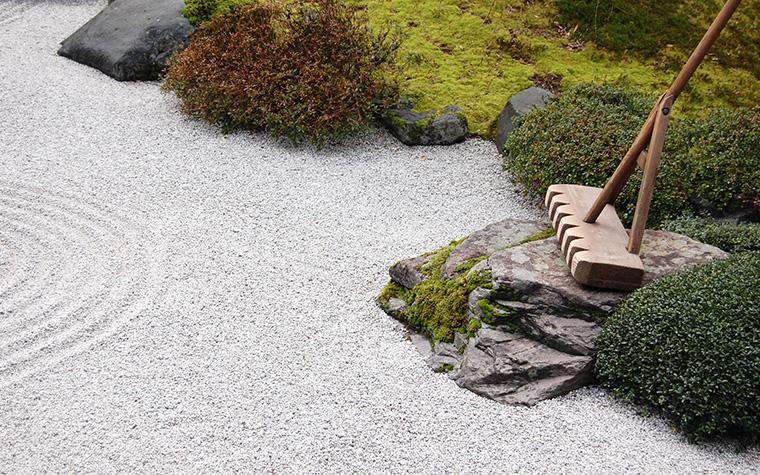
Zen gardens are minimalist, low-maintenance Japanese dry landscapes featuring raked sand/gravel, arranged rocks, and relatively few plants. They focus on restoring personal balance and encouraging individuals to embark on a journey toward enlightenment.
The word “Zen” means meditation. It is closely linked to a school of Buddhism that emphasizes direct, intuitive understanding of reality, primarily through meditation. In popular culture, Zen refers to a state of calm, simplicity, and a minimalist aesthetic.
“All elements in a Zen garden tell a story,” said Trinklein. “In fact, symbolism is used to visually remind ordinary people of their place in the universe.” The numbers 3, 5 and 7 are considered auspicious by Japanese garden masters, with rocks often grouped into auspicious clusters.
Along with numbers, symbolism runs throughout all elements in a Zen garden. Rocks placed vertically represent heaven, while rocks with break lines pointing horizontally represent earth. Diagonally placed rocks represent humanity.
Sand or gravel, representing an empty mind, is raked into swirls resembling the way water eddies around stones and islands or patterned into waves to represent rivers.
It does not require a lot of space to create a Zen garden, said Trinklein. A side yard, a small courtyard, or a corner in the back garden makes a perfect place to create your sanctuary. Starting small may make the area more manageable and pleasurable as you learn more about creating a mindful space.
Here are some tips to get started with a Zen garden:
Select a site. Pick a spot away from noisy neighbors or busy streets. Many Zen gardens are designed to be seen from the house to provide a soothing view even when you don’t have time to meditate in the garden.
Visit virtually. Nothing is more inspiring than seeing other Zen gardens. Take an internet trip to Ryoan-ji Zen Garden in Kyoto, Japan or the Sand and Stone Garden at the Portland Japanese Gardens for inspiration.
Draw a design. Sketch the garden space, incorporating the guiding principles of Zen gardens. Asymmetry is integral in Zen gardens, as it is believed to create harmony. Design a simple, uncluttered garden that exudes a feeling of calm. Include a spot where you can sit and reflect while enjoying the view.
Think about scale. Stones are a main feature of Zen gardens, but large boulders can overwhelm a small space. Likewise, small stones become lost in vast spaces. Choose elements that look proportionally correct in your garden.
Remember color and texture. Experiment with complementary and contrasting colors, choosing darker stones that stand out in a sea of lighter gravel. The palette of a Zen garden creates a soothing aesthetic, so avoid bold blooms and rainbow foliage. Instead, incorporate plants that provide a mix of textures in shades of green, like mosses, ferns, hostas and evergreen shrubs or trees.
Select a specimen plant as a focal point in the garden that provides four seasons of beauty. Cherry, plum or Japanese maple make excellent choices for a featured tree.
Add a spot to meditate. Place a bench or chair where you can enjoy a full view of your serene space.
Maintain. Caring for the garden is an important part of the meditative process. Rake the gravel to keep patterns sharp and fresh. Pick up fallen leaves and remove weeds for a pristine, clutter-free garden.
Enjoy. Leave your mental “to-do” list outside the garden. Your goal is to reflect, relax, re-energize and reconnect with nature as you enjoy your Zen garden.
Adapted from an article by the National Garden Bureau.