Bindweed gall mites unreliable in Missouri climate.
-
Image
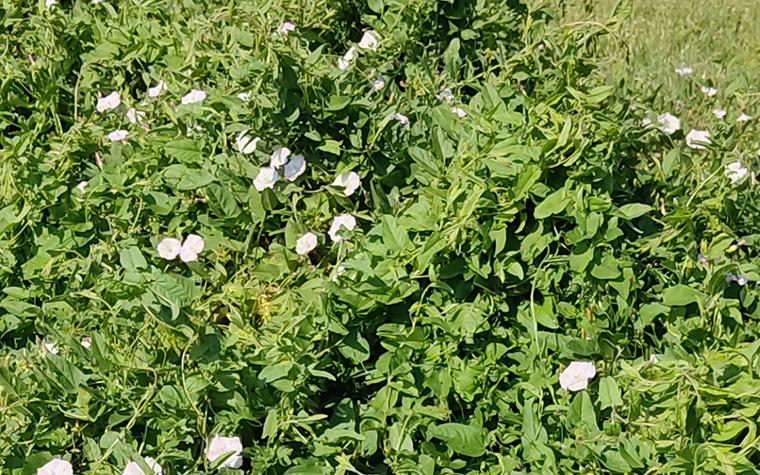 Field bindweed is a persistent perennial weed that competes with and smothers other plants. Photo by Tamra Reall.
KANSAS CITY, Mo. – Field bindweed is a persistent perennial weed that challenges Missouri gardeners, farmers and land managers by competing with and smothering other plants.
Field bindweed is one of those weeds that calls for the “right tool, right place, right conditions” approach, says University of Missouri Extension horticulturist Tamra Reall.
Its extensive root system and ability to regenerate from root fragments make field bindweed difficult to control. This has led to interest in alternative management strategies such as biological control.
Bindweed gall mites have received attention as a possible control method, says Reall. These microscopic mites feed on bindweed, causing distorted growth and reducing plant vigor. Research in Colorado showed that bindweed gall mites can reduce bindweed growth under specific conditions, especially in dryland rangeland systems.
Missouri’s climate differs substantially from the semi-arid environments where bindweed gall mites have shown success. “Their performance is inconsistent under local conditions, and they are not considered a dependable management tool,” Reall says. “Instead, effective bindweed management in Missouri requires an integrated approach.”
Repeated mechanical removal can reduce root reserves over time, while carefully timed herbicide applications may improve control of severe infestations. “Persistence and consistent monitoring are essential, as no single method provides complete control,” says Reall.
“Biological control remains an important area of research, but its success depends on matching the right organism to the right environment. In the case of bindweed gall mites, current evidence indicates that they are not well-suited for Missouri conditions,” she says.
Preventing new infestations is also important because field bindweed spreads through both seeds and root fragments. Avoid moving contaminated soil, plant material or equipment between sites.
For effective control in Missouri, focus on mechanical, cultural and chemical control, such as:
- Mechanical: Remove new growth and leaves every 1-2 weeks by digging with a garden fork or deep cultivation tool to remove as much root as possible. One-time tilling can spread the tenacious roots and create new plants.
- Cultural: Maintain dense vegetation where possible, apply mulch, or use opaque coverings to suppress growth. Long-term smothering can weaken established plants, but persistent infestations require continued monitoring. Do not leave soil bare after weeding.
- Chemical: Apply herbicides at bud-to-bloom stage or early fall when plants are actively moving resources to their roots. Random applications are unlikely to provide effective control. Visit your local MU Extension horticulturist or agronomist to learn about chemical control methods.
The search for effective biological controls continues, but for now, Missouri gardeners and land managers will see the best results by combining proven management practices and sticking with them over time, Reall says.
Photos
Bindweed in raised bed garden. Field bindweed is a persistent perennial weed that competes with and smothers other plants. Photo by Tamra Reall.
.jpg)