-
Image
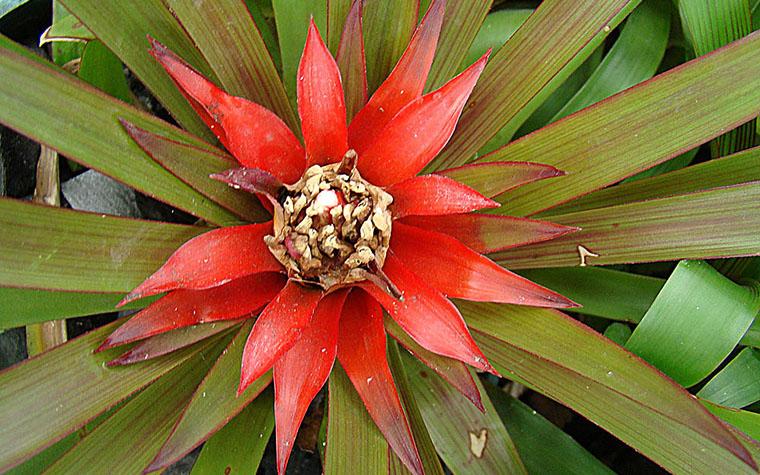 Scarlet star (Guzmania lingulate) is a popular bromeliad. Photo by Dick Cuthbert via Flickr. Shared under a Creative Commons license (CC-BY-2.0).
COLUMBIA, Mo. – During the cold and dreary days of winter, most plant lovers turn their attention indoors. Bromeliads are durable, colorful plants that adapt quite well to indoor conditions, said University of Missouri Extension horticulturist David Trinklein.
Bromeliads are characterized by foliage that usually grows as a rosette and often is vividly colored or patterned. Their colorful, exquisite flowers are unlike any other in the plant kingdom, Trinklein said.
Named after Swedish botanist Olaus Bromel, the Bromeliaceae, or pineapple, family of plants is mainly native to the tropical Americas. While some are terrestrial, most bromeliads are epiphytic, taking root on tree branches in the understory of tropical rain forests. There are more than 3,500 species of bromeliads, most of which do not have common names. Instead, they are known by their genus designation such as Aechmea, Bilbergia, Guzmania, Neoregalia, Tillandsia and Vriesea.
Bromeliads are not demanding as houseplants, and their attractive leaves give them continual interest. “Leaves range from broad, flat and leathery to fine, soft and graceful, depending on species,” said Trinklein.
Leaves range in color from maroon, through shades of green, to gold. Some may have variegated leaves suffused with red, yellow and/or white. Other bromeliads have leaves spotted with purple, red or cream; the bottom leaves of some are different in color from those at top.
The inflorescence of most bromeliads takes the form of an elaborate and vividly colored spike enclosed in a colorful sheath and bract structure. This structure remains attractive long after the true flowers have faded, giving the plant extended color. Bracts may survive and be attractive for several months or even up to a year, depending on species and environmental conditions.
In nature, ephiphytic bromeliads grow without soil, clinging to trees for support. Even the terrestrial types grow in rocky soils that hold very little water. Therefore, Trinklein recommends a well-drained growing medium for bromeliads as indoor plants. Shredded bark, leaf mold or peat moss combined with bark, perlite, coarse sand or clay pot shards can provide needed aeration and drainage.
For best indoor performance, place bromeliads in bright, diffused light. Species with hard, thick leaves can put up with brighter light than species with soft, thin leaves. A yellowish or pale green plant may indicate that the light level is too high. Conversely, dark green, soft, drooping leaves may mean that light is too low.
In the home, bromeliads need only light fertilization once a month when the plants are actively growing. Although they need constant moisture around their roots, excessive moisture encourages root rot. Keeping a bromeliad’s rosette (cup) full of water is considered by many to be a good cultural practice. However, do not put a fertilizer solution into the cup.
Bromeliads are not overly particular about temperature. Comfortable household temperatures will suit most bromeliads. Although bromeliads prefer high humidity, those with thick, leathery leaves are tolerant of the lower humidity found in most indoor settings.
According to Trinklein, some of the more popular bromeliads include silver vase (Aechmea fasciata), triblushing (Neoregelia carolinae ‘Tricolor’), scarlet star (Guzmania lingulata) and flaming sword (Vriesea splendens). All are epiphytic bromeliads that enjoy warm temperatures and are relatively easy to care for in the average home.
Photo
Scarlet star (Guzmania lingulate) is a popular bromeliad. Photo by Dick Cuthbert via Flickr. Shared under a Creative Commons license (CC-BY-2.0).