Small clove, big impact: garlic’s culinary and health benefits.
-
Image
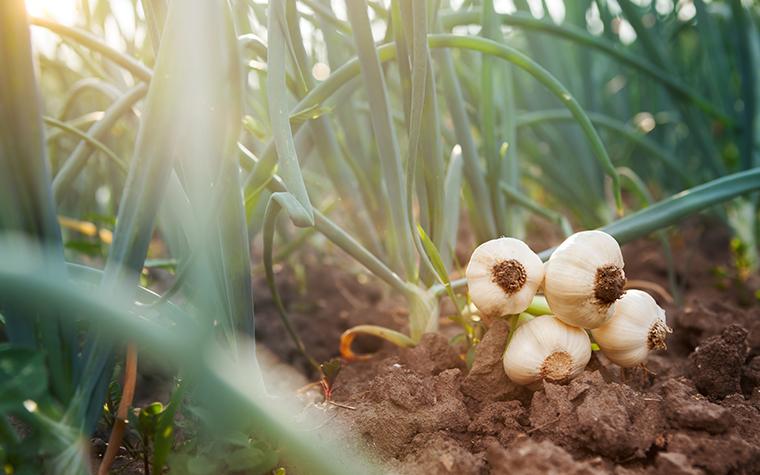 Adobe stock photo
COLUMBIA, Mo.— Garlic is nature’s delicious paradox, a culinary superhero that breathes life into your meals while simultaneously repelling everyone within a 6-foot radius of your mouth. With a unique aroma and taste, garlic has become one of America’s favorite flavoring agents, said University of Missouri Extension horticulturist David Trinklein. For home gardeners, September is an ideal month to plant this powerhouse of flavor.
The garlic cultivated today, Allium sativum, does not appear in the wild. However, there is strong evidence that it originated in central Asia as a chance mutation of a bulbous plant which often is referred to as wild garlic (Allium ursinum). Most scholars agree that garlic has been used as a medicinal plant and food source for more than 7,000 years, making it one of the most ancient of cultivated plants.
The common name garlic was derived from the Old English word garleac, which means “spear leek,” referring to the lanceolate shape of the plant’s cloves. A garlic clove is one of the small, individual wedge-shaped segments that make up a garlic bulb. Today, there reportedly are about 600 cultivars of garlic available, and they are classified as hardneck or softneck.
Hardneck types produce a flowering stalk (scape) which is surrounded by underground bulbs of cloves. Hardneck varieties are more flavorful and easier to peel than softneck, making them the choice of most chefs. Unfortunately, hardneck types do not store well.
Softneck types generally do not flower and form seeds, but they often produce bulblets on their stems. They are more productive and easier to grow than hardneck varieties. Under proper conditions, softneck varieties can be stored from six to eight months. Most of the garlic found at supermarkets is the softneck type.
A cool-season crop, garlic grows best in a sunny location in soil that is well-drained yet moisture-retentive and relatively high in organic matter. Well-rotted manure or compost is an ideal soil amendment. Garlic prefers a soil pH between 6 and 7. Liming is recommended if the pH falls below 5.8. Application rates should be based on soil test results.
Garlic normally is planted in September, after the weather moderates somewhat. Fall planting allows roots to develop but not shoots. Shoots that develop will die during the winter, and the energy used by the plant to produce them is wasted.
Garlic does not compete well with weeds, so select a site that is free of perennial weeds and well-tilled before planting. Plant individual cloves 2 to 3 inches below the soil line with their pointed side up. Spacing should be about 6 inches within rows. Do not separate cloves from the main bulb until the day of planting. Do not plant garlic purchased from a supermarket. Buy garlic cloves from a reliable seed source.
Garlic has moderate to high fertility requirements, especially for nitrogen. Before planting, amend soil based on soil test results. In the absence of a soil test, incorporate 1 to 2 pounds of garden fertilizer, such as 10-10-10, per 100 square feet of garden area before planting. You can make a supplemental application of nitrogen as soon as the leaves emerge in the spring and again about two weeks later.
Use supplemental irrigation in rainfall is insufficient. To avoid bulb rotting, don’t apply too much water. Also, do not irrigate garlic once the leaves begin to mature and dry.
Garlic is relatively pest-free. Insects that can become a problem include thrips, onion maggots and wireworms. Diseases that can infect garlic include botrytis, powdery mildew pink root and purple blotch. Good sanitation and crop rotation can help alleviate most pest problems.
In the Midwest, garlic usually is ready to harvest from between the second week of July through the first week of August the year following planting. Harvest date varies according to variety. Bulbs harvested too soon do not store well. In contrast, harvesting bulbs after their peak maturity causes individual cloves to “pop” out of their skin. Generally, begin harvesting when the lower leaves turn brown and about half of the upper leaves remain green.
Garlic is best stored at relatively low temperatures (32-38 F) under conditions of moderate humidity (about 60%). Storage life depends on type. Hardneck types will store for three or four months; softneck types can be stored for six to eight months.