Pettis County native Richard Maltsbarger says hands-on learning through Missouri 4-H helped sparked a career that led from software development to the executive suite of international companies.
-
Image
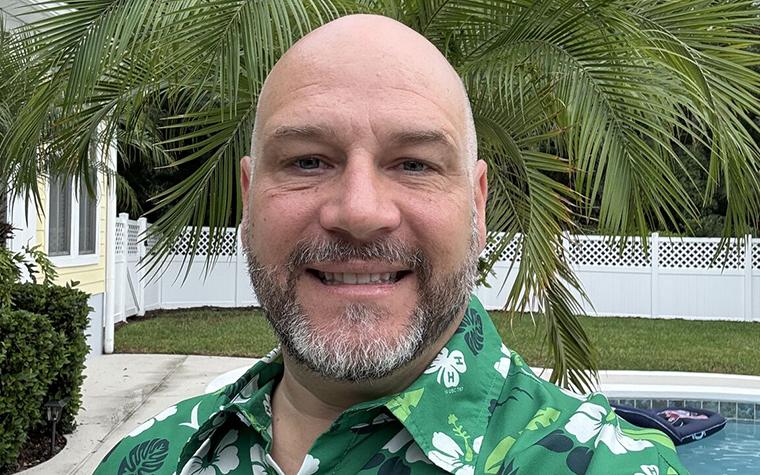 Maltsbarger wears his 4-H colors on "Go Green" day, the first Monday of National 4-H Week in October 2025.
 -
Image
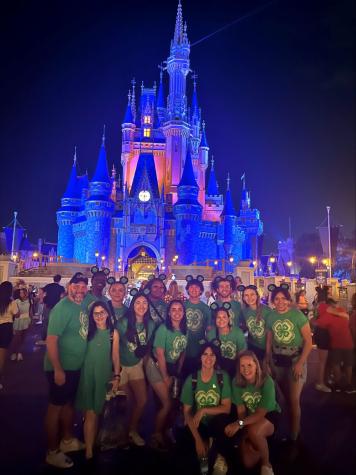 Last year, Richard Maltsbarger led a leadership development trip to Walt Disney World for members of the national 4-H Young Alumni Advisory Council.
CELEBRATION, Fla. – As a 10-year-old 4-H’er in Pettis County, Mo., Richard Maltsbarger undertook an ambitious woodworking project: a desk. “It wasn’t very stable,” he recalls. “But I had the opportunity to take it apart, redesign it, and try again.” And then again.
Eventually, he built something he called a “desk-shaped desk.” It was sturdy enough to support a computer, which he used to teach himself to code. “I took those lessons learned from failing at 4-H with hands-on experience with woodworking and other projects and turned it into hands-on coding experience, where there’s a lot of failure. You practice and try again.”
Thanks to that practice, he was able to partially pay his way through college in the mid-1990s as a freelance software and website developer, launching a successful career that has included serving as president of international and chief operating officer of Lowe’s and chief executive officer of Pet Valu, a major pet specialty retailer in Canada.
“I credit 4-H for opening up my horizons,” he said. “I also credit 4-H for giving me the understanding that failure is a practice. It’s not a permanent state.”
Maltsbarger grew up near Green Ridge, where the family raised beef cattle and row crops on his grandfather’s farm. The family also had an excavation business. “We dug basements, we dug sewer lines. We put in driveways and other major excavation projects with bulldozers, backhoes and dump trucks.”
Founded more than a century ago, 4-H is the youth development program of the nation's land-grant university system, administered through the U.S. Department of Agriculture and the nation’s Cooperative Extension system. It provides a structured environment for young people to explore a variety of interests and career paths.
As a 4-H’er, Maltsberger was able to learn about woodworking, shooting sports, public speaking and leadership. He also helped with his cousin Tara’s purebred Polled Hereford cattle projects.
A broader view of the world
Just as important, 4-H expanded his view of what was possible. “It is what gave me my first broader perspective on how many things and how many places there were in the world.”
Through club activities, statewide events and trips to the Missouri State Fair, he met young people from across Missouri and beyond. Adult volunteers introduced him to experiences and careers he had never imagined.
“It really changed my mindset,” he said.
One destination quickly became fixed in his imagination. “When I was 9 and 10 years old, 4-H is what Mizzou was to me,” he said. “By the time I was a seventh grader, I’d already decided I was going to Mizzou.”
He followed through, earning bachelor’s and master’s degrees in agricultural economics from the University of Missouri before completing an MBA at Washington University in St. Louis. Along the way, he shifted from software development into quantitative analytics—what today would be called big data.
His career took him from Farmland Industries and Monsanto to IBM, where international assignments broadened his perspective even further. He later joined Lowe’s, advancing through leadership positions that included customer analytics, research, strategy, international operations and ultimately chief operating officer. As CEO of Pet Valu, he led the company through the COVID-19 pandemic, an initial public offering and years of rapid growth.
Maltsbarger retired from Pet Valu in 2025. Today, he advises emerging technology companies, co-founded a venture capital firm focused on housing innovation and serves on several corporate boards. He is also executive in residence at the University of Central Florida, working with an interdisciplinary team to launch an executive education school called the School of Technology Leadership and Innovation.
Learning never stops
Throughout that journey, he says one lesson from 4-H has remained constant: never stop learning.
As CEO, he helped design leadership development courses and worked with his executive team to have each taught the company’s most senior leaders. “I thought it was important to understand that everybody, even the CEO, has things to learn,” he said.
That same philosophy recently led him back to the classroom to earn a higher education teaching certificate from Harvard University’s Derek Bok Center for Teaching and Learning to prepare for his role at the University of Central Florida as he prepares curriculum for executive education programs.
“I encourage every person in their career to never stop learning,” he said. “I like to be the example of that.”
4-H also shaped his understanding of leadership.
“It taught me that leadership isn’t about being the most experienced, the oldest or the most powerful person in the room,” he said. “It’s about stepping up in the moment.” As a young member, he watched teenagers willingly take responsibility because they had knowledge to share or simply the willingness to lead.
Seven years ago, Maltsbarger found another opportunity to serve the organization that helped shape him when he joined the National 4-H Council Board of Trustees. He now serves as the board’s treasurer and chairs the internal affairs committee.
His involvement, he says, isn’t simply about giving back. It’s about investing in the nation’s future. “There are no other youth organizations with over 125 years of history, with local agents and program leaders in every single state, county and parish across the United States, that can bring the power of learning by doing and understanding what opportunities exist to youth better than 4-H,” he said. “I believe in the mission.”
That conviction is reflected in Beyond Ready, the National 4-H Council’s campaign to expand opportunity for young people across America. The initiative seeks to grow 4-H participation from 6 million to 10 million youths while raising more than $500 million to strengthen programming nationwide.
Maltsbarger believes those investments have become even more important as rapidly changing technologies reshape the workforce.
Schools provide the academic foundation, he says, but 4-H develops the skills employers increasingly value.
“4-H has the opportunity to extend that further through hands-on learning, apprenticeships, active involvement, civic engagement, public speaking and other skills that create critical thinking and human interaction skills that are even more important now as we live in such a technologically advanced age.”
He believes the organization’s greatest strength is giving young people a place to experiment without fear.
“It gives you a structured environment in which to try something and fail and try again,” he said. “It takes away some of that fear of trying something new,” he said. “Of being a novice. Of stretching into an area that you otherwise are interested in but know you’re definitely not an expert at.”
For Richard Maltsbarger, that willingness to keep rebuilding—from a desk-shaped desk to a global business career—began in 4-H.
About Missouri 4-H
Missouri 4-H grows today’s youth and prepares tomorrow’s leaders. With a blend of time-tested traditions and innovative hands-on learning, Missouri youth explore and find their spark in programs ranging from agriculture and conservation to aerospace and career development. Through clubs, programs, camps, in-school and after-school experiences, University of Missouri Extension faculty, staff and thousands of volunteers guide youth in developing essential skills, building confidence and fostering connections. Together, they inspire young people to make a real difference in their communities, their country and the world.