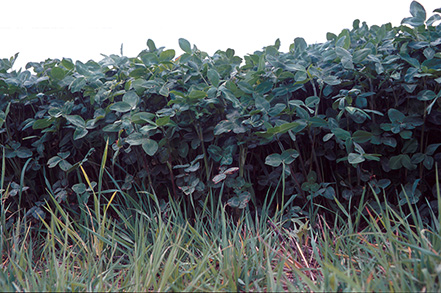
Red clover (Trifolium pratense L.) remains one of the most important and practical legumes for Missouri forage systems (Figure 1). Although other forage crops may offer higher yields or longer persistence, few match red clover’s ability to establish quickly and deliver high-quality forage, especially on marginal soils. From rejuvenating fescue pastures to boosting hayfields, red clover continues to prove its value season after season.
Types of red clover
Red clover is usually grouped into two types: medium and mammoth. Medium red clover flowers earlier and is the most common type grown in Missouri. It is a short-lived perennial, with most plants living about two years, and usually produces two or three hay cuttings each year. Red clover has pink flowers; trifoliate leaves (leaves divided into three leaflets) with distinct watermarks; and pubescent leaves and stems (i.e., covered with fine, soft, short hairs) (Figure 2). Mammoth red clover grows taller and has slightly coarser stems. It is not well suited for most Missouri forage systems because it usually produces only one cutting and does not regrow well after harvest. In the rest of this publication, red clover refers to medium red clover.

Benefits and adaptation
Red clover grows well in many places where alfalfa does not. It handles moderately acidic soils, wetter soils, and lower fertility better than alfalfa. Red clover fixes nitrogen from the air when the correct bacteria form small nodules on its roots. This process provides nitrogen for the red clover plant. Red clover has taproots that help it reach water and nutrients deep in the soil, enabling the plant to tolerate moderately dry years. Red clover plants usually do not live as long as alfalfa. Root diseases and drought can shorten the life of the stand. However, red clover seed is usually affordable and easy to reestablish, making it a practical and flexible choice for many forage systems.
Recommended varieties
New red clover varieties are released regularly, offering improved yield, persistence and disease resistance. Before buying seed, ask for unbiased performance data to ensure the variety suits your management system and goals. Certified seed that meets the purity and germination requirements set by the industry is best.
One notable advancement in red clover breeding is the development of varieties with resistance to 2,4- D herbicide. “Q” Medium Red Clover, developed by the University of Florida, is a non-GMO variety bred specifically to tolerate applications of 2,4-D. This trait is especially valuable in mixed grass–red clover pastures, where weed pressure is high and conventional herbicide options are limited.
Establishment guidelines
Red clover establishes easily with good management. Producers can help it get started by ensuring good seed-to-soil contact and reducing competition from other plants. Do not apply nitrogen fertilizer when planting red clover into grass pastures. Nitrogen helps the surrounding grass grow faster, does not benefit the red clover, and can cause grass to crowd out young red clover seedlings. Inoculate red clover seed with the correct rhizobium, Rhizobium trifolii, before planting, especially if red clover has not grown in the field recently.
Establishment methods and timings
Key methods of red clover establishment include frost seeding, early fall broadcast seeding, drilling into a conventionally prepared seedbed, or no-till planting. Regardless of the establishment method chosen, take the time to calibrate planting equipment, monitor seed placement, and adjust for changing field conditions. Accurate seed depth and consistent placement are crucial to establishing a uniform, vigorous stand.
Winter (Frost) seeding
Broadcast seeding in February, known as “frost seeding,” is a reliable method for establishing red clover in Missouri. This technique takes advantage of natural freeze–thaw cycles to work seed into the soil with minimal disturbance. Frost seeding is most effective when done on dormant grass sods with little residual forage. Heavy grazing is commonly used to reduce residue before frost seeding. Controlled burning in late winter, before seeding red clover, is another effective option. Burning removes old growth and reduces grass competition as the red clover seedlings become established.
Early fall broadcast seeding
Another effective, though less commonly used, approach is broadcasting seed into heavily grazed sod in early September. In some years, this method outperforms frost seeding. Although not widely practiced, it provides a valuable establishment window when spring seeding is not possible or when producers want to thicken a stand before the next growing season.
Conventional tillage
Red clover can be successfully established by drilling into a firm, weed-free seedbed between mid-August and late September. Seed should be placed no deeper than ½ inch and firmed with a roller or cultipacker to ensure good seed-to-soil contact.
No-till systems
Red clover may also be no-till drilled into existing grass sods or into clean fields following a nonselective burndown herbicide application. In some renovation scenarios, herbicides are used to suppress an existing grass sod to reduce competition, though this practice is not common in Missouri.
No-till planting can be done in either early spring (March through April) or late summer (mid-August to late September). Many producers prefer no-till systems for their ability to minimize soil erosion and preserve soil structure. Optimal seeding depth is ¼ to ½ inch. Press wheels should firm the furrow without burying seeds too deeply.
Fertility management
Use a soil test to check pH, phosphorus and potassium levels before planting red clover. Retest the soil every three years to stay current. Apply lime if the soil pH is too low. Red clover grows best when soil pH is between 6.0 and 7.0. Red clover produces more forage and lasts longer when soil phosphorus and potassium levels are at least medium. Apply phosphorus and potassium fertilizer only when the soil test shows a need. Keeping these nutrients at the right levels helps the stand stay healthy and productive.
Avoid applying nitrogen fertilizer at seeding, as it encourages grass growth and increases competition with young clover seedlings. Instead, apply lime, phosphorus and potassium based on soil test results to support root development and early plant vigor.
Heavy nitrogen applications the fall before seeding — often used to stockpile tall fescue — can dramatically reduce red clover establishment. In multiyear trials, applying 0 to 300 pounds per acre of nitrogen in the fall reduced red clover seedling density by up to 90% when seeded into those sods the following winter (Kallenbach et al., 2017). Up to 50 pounds per acre of nitrogen in the fall is generally acceptable, but avoid higher rates or spring applications if clover establishment is the goal.
Maintaining red clover in mixed stands
Red clover is a short-lived perennial. Most plants stay productive for about two years. Therefore, producers should not expect one planting to last for many years. A good way to keep red clover in a grass-legume pasture is to broadcast 3 to 6 pounds of seed per acre each year. This yearly seeding keeps new plants coming into the stand. As older plants die out, younger plants take their place. Over time, this creates a steady stand of red clover. After a few years, the pasture should have red clover plants of different ages. The second-year plants are especially important because they usually produce the most forage. This yearly overseeding helps keep red clover in the pasture without having to start over with a new seeding.
Use higher seeding rates — 10 to 12 pounds per acre — when overseeding into dense grass stands or when conditions are less than ideal. Delay grazing until new clover reaches 8 to 10 inches in height to ensure proper root development and stand persistence. Once established, pastures with red clover often outperform those fertilized solely with nitrogen, offering both economic and agronomic advantages.
In the establishment year, allow red clover to root deeply before initiating grazing. A light grazing in late summer helps remove competition, but avoid overgrazing, which can damage young stands. In subsequent years, implement a rotational stocking schedule to maximize forage quality and stand longevity. Rotational systems that allow rest periods between grazing or cutting cycles help maintain root reserves and shoot density.
Managing for hay or silage
Hay fields should be harvested at early to mid-bloom to balance quality and yield. Delaying harvest reduces crude protein, digestibility and regrowth potential. After mid-September, allow clover stands to rest and rebuild reserves for winter survival. Once temperatures fall below 20 degrees F for a few nights, the plants go winter dormant. Red clover can be safely grazed after entering dormancy without harming the stand, but it should be grazed soon after dormancy begins. Forage quality declines rapidly once the plants go dormant.
Seed production
Natural reseeding in pastures can occur if managed correctly by allowing red clover to blossom and produce seed before grazing in mid- to late-summer.
Red clover seed can be combine harvested from second-year stands. Seed is usually taken from the growth that would have been the second cutting of the year. Good pollination is important. Honeybees are needed for strong seed production. Place about one hive for every two acres when 5% to 10% of the flowers are open. Harvest when the flower heads turn brown and the seed has developed color. Cutting the crop into windrows while it is still slightly moist can help reduce seed loss. Doing so helps keep the seed from shattering before or during threshing. Clean, high-quality red clover seed can bring a strong price, especially when it comes from certified varieties. Seed production takes more planning than forage production, but it can be a good opportunity for dedicated growers who have the right equipment, can manage harvest timing, and can protect pollinators.
Harvesting for hay or silage
Red clover harvested for hay or silage at early to mid-bloom can have about the same protein level as alfalfa, usually 14% to 16%. It also has good digestibility and is readily eaten by many types of livestock.
Harvest timing is important. If harvest is delayed past mid-bloom, forage quality decreases because protein levels drop, fiber increases, and the plant becomes stemmy.
To maximize forage nutrition and minimize equipment wear, producers may choose to graze summer regrowth instead of harvesting it for hay.
In rare cases, livestock fed second-cutting red clover hay may slobber. This slobbering is caused by compounds from the fungus Rhizoctonia leguminicola. Slobbers can look unpleasant but are usually harmless. The simplest way to reduce this problem is to graze the regrowth instead of making hay from it. Cutting at the right stage, curing hay properly, and storing hay in dry conditions can also help reduce the risk.
Pest management
Red clover is generally a low-maintenance legume, but monitoring for pests is still necessary. Insects such as clover root curculio, clover leaf weevil, aphids, and armyworms can reduce yield and persistence if left unchecked. Scout fields regularly, especially during establishment. Infestations can spread quickly in warm, dry weather. Seed crops require extra care to protect pollinators; avoid insecticide applications during bloom and use integrated pest management (IPM) strategies when possible.
For chemical weed control, refer to MU Extension publication IPM1031, Weed and Brush Control Guide, which outlines approved herbicide options and timing. Combining chemical control with improved cultural practices such as fertility management, rotational stocking, and timely mowing yields the best long-term results.
Conclusion
Red clover continues to be a cornerstone of Missouri forage systems. With flexible establishment options, good forage quality, and compatibility with cool-season grasses, it consistently delivers value for both grazing and stored forage systems. Whether you’re building soil, boosting protein in your ration, or extending grazing days, red clover remains a dependable, productive and sustainable choice for Missouri producers.
Additional resources
Bradley, K.W. (2014). Weed and brush control guide for forages, pastures and noncropland. University of Missouri, Extension Division: IPM1031. Columbia, Missouri.
Kallenbach, R.L., and G.J. Bishop-Hurley. 2004. A guide to the common forages and weeds of pastures. University of Missouri, Extension Division: M169. Columbia, Missouri.
Kallenbach, R.L., C.A. Roberts, J.A. Lory, and S.A. Hamilton. 2017. Nitrogen fertilization rates influence stockpiled tall fescue forage through winter. Crop Sci. 57:1732-1741.
Munoz, P., Quesenberry, K., Blount, A., Ferrell, J., Dubeux, J. (2015). A new red clover 2,4-D-resistant cultivar to improve broadleaf weed control and elucidate the molecular mechanism of resistance. In: Budak, H., Spangenberg, G. (eds) Molecular Breeding of Forage and Turf. Springer, Cham.