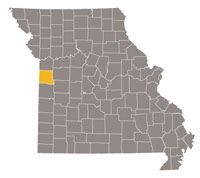
Location of Cass County Extension Center, Missouri

Cass County Extension Center

Home Food Preservation Workshops
                 

These workshops are designed for beginners or those who need to update their skills.  Hands-on experience with new recipes and sources of the
latest research.  Each session covers a specific preservation method to use for highest quality and safety in home preserved foods.  Solutions to
common problems and challenges when canning.  For more information contact University of Missouri Extension at 816-380-8460.
Preserve Your Harvest Safely (PDF) 

May 22 - Pressure Canning 101 has been cancelled and will be rescheduled at a later date.   

Goat production workshop series

This series of workshops is designed to provide goat producers knowledge in the areas of nutrition, reproduction, health and economics of raising goats. The goal is that goat producers would use knowledge from these workshops to improve there goat operation.   Workshop - June 28, 2012
Goat production workshop series flyer (PDF) 


Is it cost-effective to bale your own hay?

Warm temperatures and intermittent rain showers have awakened Missouri pastures earlier in 2012 than in most previous years. The green of pastures and warm temperatures have ruminant livestock owners thinking about haying season. Because hay is a relatively inexpensive feed when grass is unavailable, many livestock owners want to produce hay for the winter from the abundance of grass that their pastures yield in the spring. In order to obtain hay, some farmers choose to own and operate their own hay equipment. Others choose to use a custom baler or purchase hay. This article discusses the cost effectiveness of owning and operating hay equipment versus hiring a custom baler.

In order to evaluate the cost-effectiveness of owning and operating hay equipment, a livestock owner needs several pieces of information.  First, he needs to know his costs of both owning and operating a fleet of hay machinery. Machinery ownership costs include depreciation, insurance, interest, and property taxes. These costs are dependent upon the market value of the equipment, the manner in which each equipment purchase is financed, insurance costs, and property tax rates. Machinery ownership costs are often prohibitive when equipment is not utilized to its full capacity or when the hay produced has little value. Machinery ownership costs are relatively fixed in the short-run, meaning that no matter the amount of hay baled, ownership costs do not change for the hay enterprise.  However, when calculating production costs for each unit of hay produced, these costs are spread out over all units of production.  Therefore, the situation of owning hay equipment is made more favorable when the volume of hay produced with the equipment can be increased.

In addition to ownership costs, operating costs affect the cost-effectiveness scenario of baling hay. Operating cost include labor, fuel, maintenance, and repairs due to equipment use. These costs are considered variable costs because the cumulative dollar value of these expenses will vary with the quantity of hay baled. Like ownership costs, these costs are, theoretically, spread across all units of production. Adding ownership and operating costs together, produces a dollar figure that equals the total cost of owning and operating the given set of hay equipment.  Dividing the total ownership and operating cost by the units of hay baled provides a dollar value that signifies the ownership and operating costs embodied in each unit of hay.

After a hay producer has calculated his machinery ownership and operating costs per unit of hay, he can compare his costs to the going custom rate for hay baling.  When a hay producer’s machinery ownership and operating costs are less than the custom rate, it is cost-effective for the hay producer to bale his own hay. When his costs are greater than the custom rate, he should consider hiring a custom baler.

For more information on machinery economics and a copy of MU Extension’s custom rate guide contact a county Extension office or go online to www.extension.missouri.edu/p/G302.  Whitney Wiegel, Agricultural Business Specialist

Helping children learn to cope with stress

Stress is a natural response to change, demands, or pressures of life such as family changes, job changes, personal loss, illness, changes in life styles, etc.  Stress can be good as well as bad.  Stress can boost our energy to enjoy life more.  But too much stress can make us overwhelmed, unhappy, and cranky.

No matter how old we are, everyone experiences stress.  Children are not an exception.  They have stress too. They feel stress from time to time.  The sources of stress on children include going to day care or school for the first time, being away from home, constant changes in schools, neighborhoods, and child care arrangements, peer pressure, moving to new living environments, the birth of a sibling, birthday parties, vacation trips, dealing with strangers as an infant, fear of the dark, adjusting to a growing body during the preteen years, parent’s divorce or separation, parents being called to war, parent’s unemployment, family illness or death, family conflicts, violence in their homes and communities, natural disasters, etc.

Every child reacts to stress differently.  Some children seem to be born with easy going personalities. Other children tend to be upset and be disrupted by new situations and challenges easily.  Although we cannot change their personalities, we can teach children ways of managing stress and reducing harmful stress.  Here are some tips:

  • Spend one-to-one time with your children each day.
  • Keep communication lines open with your children.
  • Set clear rules and consequences and have realistic expectations. 
  • Encourage children to talk about what is bothering them.
  • Encourage healthy eating and physical activities.
  • Help children have enough sleep.
  • Identify the cause of the stress.
  • Teach children how to relax, make decisions, and solve problems.
  • Provide your children with a sense of security.
  • Monitor your own stress levels.  Be a role model for your children.

Nina Chen, Ph.D., Human Development Specialist