Annual lespedeza is a warm-season annual legume valued for pasture, hay production, and soil improvement. It is well adapted to challenging conditions, tolerating low soil pH, low fertility, and drought—traits that have made it a dependable forage across much of Missouri. Two species of annual lespedeza are commonly grown in the state: common lespedeza Kummerowia striata and Korean lespedeza Kummerowia stipulacea.
Common lespedeza, a striate type, was first reported in Georgia in 1846 and appeared in southern Missouri shortly after the Civil War. A related striate variety, Kobe lespedeza, was introduced from Japan in 1919. Kobe grows larger and more upright than common lespedeza and produces higher yields of hay and forage. Striate types mature later in the season and require a longer growing period, making them better suited to southern Missouri and states farther south. Common lespedeza, however, remains more tolerant of poor soil fertility and acidic conditions.
Korean lespedeza was introduced to the United States from Korea in 1919 and arrived in Missouri just two years later. In 1921, the Missouri Agricultural Experiment Station received a small sample of seed, reportedly only a spoonful, from the U.S. Department of Agriculture. After five years of intensive research at the University of Missouri, the station distributed five-pound seed packets to 30 farmers for on-farm testing. The results were overwhelmingly positive. Farmer acceptance was rapid and widespread, with Korean lespedeza acreage in Missouri peaking at nearly 6 million acres in the early 1950s.
Identification
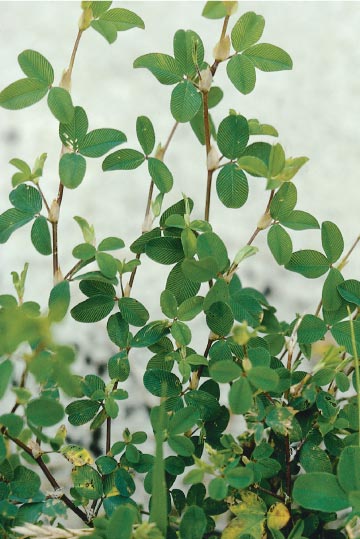
Korean lespedeza (Kummerowia stipulacea) has broad, heart-shaped leaflets with prominent veins (Figure 1), while common and Kobe lespedeza (K. striata) have longer, narrower leaves. Korean lespedeza stem hairs slant upward; those on common and Kobe lie flatter. Flowers range from light pink to purple in all types.
After flowering, Korean lespedeza leaves fold around the seed pod, reducing seed shatter. Common lespedeza does not, making it more prone to seed loss. Seed is produced in clusters at branch tips in Korean lespedeza, while common lespedeza sets seed along the stem at leaf axils.
Uses
Annual lespedeza has been widely used for summer pasture, hay, and soil improvement. Historically, it was commonly overseeded into small grains, providing summer forage after grain harvest before fields were returned to small grains. It also has been grown alone or seeded into bluegrass, orchardgrass, or tall fescue pastures. Lespedeza was widely used in Missouri pasture systems during the mid-1900s.
Growth habits
Annual lespedezas germinate in early spring but grow slowly until June. Growth and seed production are driven by day length, with most forage produced in July and August. Plants are drought tolerant and recover quickly following summer rainfall. Seedlings are more drought resistant than alfalfa or clovers. Mature plants are killed by the first hard frost.
Grazing and competition
Lespedeza tolerates close grazing and trampling. Grazing or mowing stops upright growth and promotes spreading along the soil surface. It competes well with cool-season grasses when nitrogen (N) inputs are low. N applications greater than 30 lb/acre typically reduce lespedeza stands. Close spring grazing of companion grasses improves lespedeza persistence.
Decline in use
Lespedeza acreage peaked in Missouri in the early 1950s and declined due to increased nitrogen fertilization, competition from cool-season grasses, disease pressure (including bacterial wilt and tar spot), and the adoption of higher-yielding legumes such as alfalfa and clovers.
Livestock performance
Lespedeza provides fine-stemmed, leafy forage that does not cause bloat and is well suited for midsummer grazing when cool-season grasses decline in quality. Research trials have shown:
- Daily gains of 1.7–2.0 lb/day for beef steers
- Beef production of 200–285 lb/acre depending on system and location
It is well suited for cattle backgrounding and sheep and can be grazed by dairy heifers. Grazing mature lespedeza after bloom may reduce milk production in lactating dairy cows.
Management guidelines
- Limit nitrogen applications to 20–30 lb N/acre
- Use close spring grazing to reduce grass competition
- Best performance with orchardgrass and tall fescue, but compatible with most cool and warm-season grasses
- Reliable reseeding under proper grazing management
Additional benefits
Annual lespedeza seed is an excellent food source for quail, adding wildlife value to pasture systems.
Hay yield and quality
Annual lespedeza produces lower forage yields than well-managed alfalfa or clover, but it can be grown at substantially lower cost. Missouri producers typically harvest 1–2 tons per acre, depending on weather and management.
Feeding trials show lespedeza hay is only slightly lower in feeding value than alfalfa for wintering calves and dairy heifers, but it is inferior to alfalfa for lactating dairy cows. It is well suited for sheep and beef cattle. Lespedeza forage is fine-stemmed and leafy, with leaves containing roughly twice the protein concentration of stems.
Yield (Table 1) increases as plants mature, but forage quality declines as leaf percentage decreases. For best balance of yield, quality, and reseeding, lespedeza should be harvested no later than early bloom. Leaving 6–8 inches of stubble will generally produce at least 1 ton per acre while allowing plants to set seed.
Table 1. Hay and percent leaf yields of Korean lespedeza in Tennessee.
| Species | Hay yield | Leaves only | Percent leaves |
|---|---|---|---|
| Korean, pre-bloom | 1.08 tons per acre | 0.77 tons per acre | 68.42 |
| Korean, first bloom | 1.84 tons per acre | 1.17 tons per acre | 61.85 |
| Korean, late bloom | 2.37 tons per acre | 1.17 tons per acre | 53.15 |
To minimize leaf loss, cut, condition, and windrow in a single operation. Lespedeza stems contain little water, allowing rapid curing. Under good drying conditions, hay can sometimes be cut and baled on the same day.
Species Hay yield Leaves only Percent leaves Korean, pre-bloom 1.08 tons per acre 0.77 tons per acre 68.42 Korean, first bloom 1.84 tons per acre 1.17 tons per acre 61.85 Korean, late bloom 2.37 tons per acre 1.17 tons per acre 53.15.
Fertility management
Annual lespedeza grows well on most well-drained Missouri soils and tolerates low fertility, but it responds strongly to lime and phosphorus. Early Missouri research showed yields more than doubled when lime and phosphorus (and sometimes potassium) were applied. Responses are often greater after lespedeza has depleted soil nutrients over several years.
Lespedeza performs best at soil pH 5.5–6.0. Growth declines below pH 5.0. Potassium responses are most noticeable after soils have been limed and phosphated. Typical soil test recommendations for shallow Missouri soils include 40–60 lb P and 30–60 lb K per acre annually, with higher K rates for hay production.
Nitrogen fertilization strongly suppresses lespedeza (Table 2). Even 30 lb N/acre can reduce yields, and rates of 60 lb N/acre or more can severely limit summer production by increasing grass competition.
Table 2. Season distribution of forage yields with different N rates (0, 60 and 120 pounds N applied to fescue/Summit lespedeza).
| Harvest dates | 0 pounds N | 60 pounds N | 120 pounds N | |||
|---|---|---|---|---|---|---|
| Percent of total yield | Percent Legume | Percent of total yield | Percent Legume | Percent of total yield | Percent Legume | |
| May 17 | 14.2 | 0 | 56.3 | 0 | 48.4 | 0 |
| Aug. 18 | 74.1 | 71 | 35.8 | 43 | 36.3 | 34 |
| Nov. 15 | 11.7 | 7.9 | 15.3 | |||
| Total yield | 2,743 pounds per acre | 3,313 pounds per acre | 4,029 pounds per acre | |||
Seeding rates and establishment
- Pure stands: 20 lb seed/acre
- Dormant seeding into existing grass: 15 lb/acre
- Spring seeding with cool-season grass: 10 lb/acre
Certified seed contains at least 78% pure live seed, averaging about 236,000 seeds per pound.
Lespedeza is commonly established after small grains or seeded with cool-season grasses. Higher rates are needed for pure stands. In mixtures, lower rates are sufficient, especially when seeding into existing grass pasture.
Lespedeza can outcompete cool-season grass seedlings under dry conditions or late spring seedings. Light mowing or grazing during summer may be necessary to protect grass seedlings.
Seed in March or April when planting with grasses. When adding to fall-seeded or established grass, broadcast seed during winter to allow freeze–thaw action to improve seed–soil contact. Do not fall-seed lespedeza; it will germinate and be winter-killed. Apply 40–60 lb P/acre (no N) at establishment. Closely graze companion grasses early to reduce competition until lespedeza growth accelerates.
Seed inoculation is only needed where lespedeza has never been grown. Use inoculum labeled for lespedeza (often shared with cowpeas).
Varieties
The best lespedeza varieties reseed reliably and resist disease.
- Striate types (common, Kobe): Dependable reseeding primarily in southern Missouri due to longer growing season.
- Korean types: Productive but susceptible to bacterial wilt and tar spot, especially under heavy grazing.
Ongoing MU research focuses on improving forage yield, seed production, and disease resistance.
Seed production
Seed is typically harvested in October by direct combining or by combining cured windrows. Typical yields range from 200–400 lb/acre, with 500–600 lb/acre possible under good conditions. Exceptional yields over 1,000 lb/acre have been reported.
Apply lime, P, and K based on soil tests. Early clipping or light grazing can increase seed yields of Korean types but may complicate harvest due to low, spreading growth.
Seed should be recleaned to remove weed seed, particularly dodder, which closely resembles lespedeza seed. Avoid contaminated seed sources and eliminate dodder infestations before seed harvest.
Summary
Annual lespedeza is a nonbloating legume that can be grown on most soils of Missouri. It is easy to establish, reseeds itself except under severe drought conditions and produces nutritious forage during hot summer conditions. Lespedeza tolerates low fertility but responds to applications of lime and phosphorus. It provides quality pasture at a time when cool-season grasses are of low quality and are producing very little. Lespedeza produces good seed yields for combining and makes quality food for bobwhite quail.
Lespedeza grows slowly in the spring and produces very little pasture before late June. Dry matter yields of lespedeza are lower than alfalfa or clover when grown under favorable growing conditions. Lespedeza occasionally may fail to reseed under extremely hot, dry growing conditions. Kobe may not reseed in years with unseasonably early frosts. Diseases can cause serious reductions in yields of Korean lespedeza. New variety releases give some protection from diseases and add to the forage yield potential of lespedeza.